
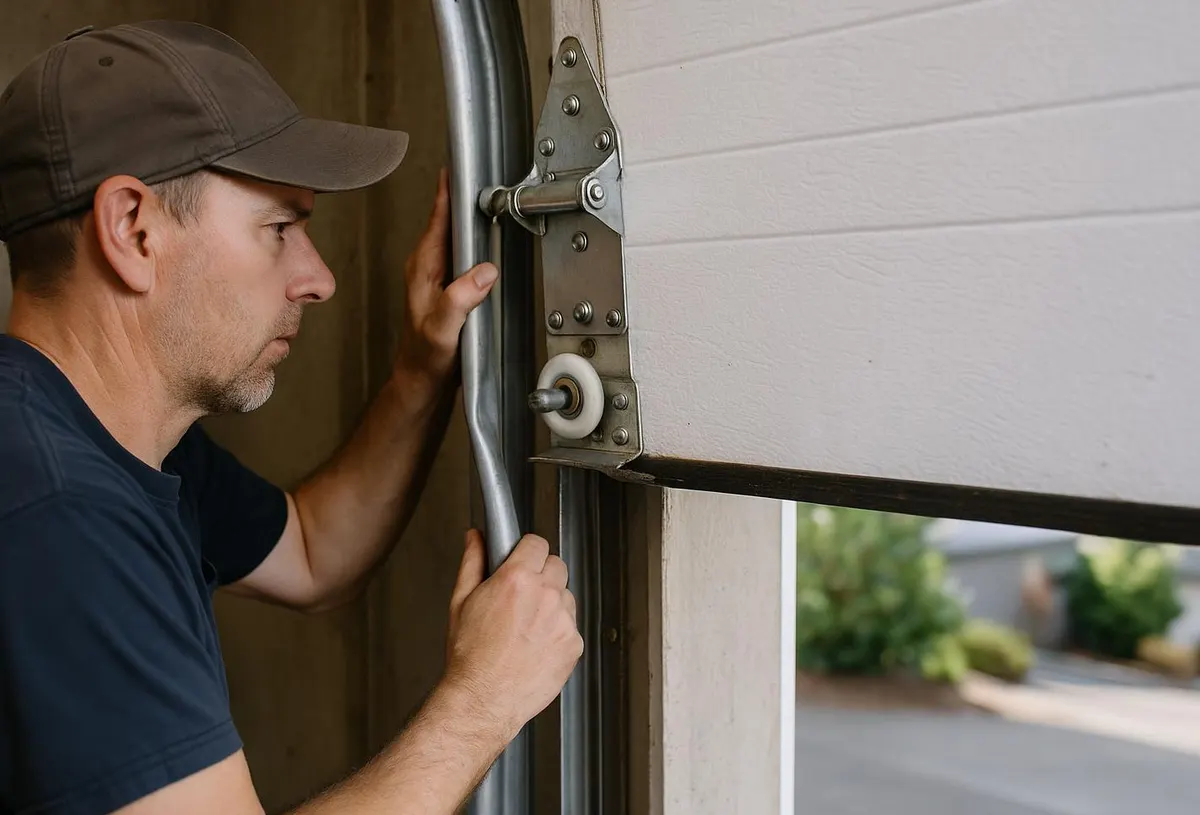
The Moment You Notice Something Is Off
You hit the button and the door doesn't glide the way it used to. It hesitates a few inches up, jerks, then keeps going. Or maybe you walk past the garage and catch it out of the corner of your eye — one corner is sitting lower than the other, like the whole panel is tilted. Sometimes it's a sound: a metallic scrape or a pop as a roller catches on something it shouldn't. None of these are things to wait out. A door running on bent or misaligned tracks is working against itself every time it opens, and the damage compounds fast.
The Symptoms That Point to a Track Problem
Track issues show up in a handful of recognizable ways. You might notice:
- Jerky or uneven movement — the door speeds up, slows down, or hitches at the same spot every cycle.
- A visible gap between a roller and the track on one side, especially near the bottom or at a bend in the track.
- A crooked resting position — the door looks tilted when fully closed or fully open.
- Grinding or scraping noise as the rollers fight their way through a narrowed or bowed section.
- The opener reversing mid-cycle because the extra resistance trips the safety or force sensors.
Any one of these on its own is worth a look. Two or more together usually means the track has already shifted enough to put real strain on the rollers, cables, and opener.
What Causes It — Checked in the Order a Technician Would Check It
1. Impact Damage
This is the first thing a tech rules out, because it's the most common and the easiest to spot. A car bumper, a bike, a lawn mower, even a basketball backboard bracket can clip the track and knock it out of alignment. The dent is often small but enough to make a roller skip or bind. A tech checks for fresh scuffs, dents, or a track that's visibly pulled away from the wall at one spot.
2. Loose or Corroded Mounting Brackets
The vertical and horizontal tracks are held to the framing by brackets and lag bolts. In homes near the coast, salt-laden air speeds up corrosion on these fasteners, and Venice's humidity doesn't help — metal brackets rust, bolts back out, and the track starts to sway with every open-and-close cycle. A tech checks each bracket by hand, looking for play, rust streaks, or screws that spin without biting. Loose brackets are retightened or replaced; badly rusted ones get swapped for galvanized hardware that holds up better in salt air.
3. Worn or Broken Rollers
Rollers that are cracked, flat-spotted, or missing their bearings don't just make noise — they put uneven pressure on the track every time they pass through a bend. Over weeks, that pressure can bow the track outward. A tech spins each roller by hand, checking for wobble, resistance, or visible wear. Damaged rollers are replaced as a set rather than one at a time, since the rest are usually close behind in wear.
4. Warped or Swollen Door Panels
Wood and composite doors absorb moisture, and Florida's humidity plus afternoon downpours give them plenty of chances to swell. A panel that's swollen or slightly warped pushes against the track from the inside, forcing it out of true even if the track itself started out straight. A tech checks the door's edges against the frame for gaps or binding, and in some cases the fix isn't the track at all — it's addressing the panel, or in older doors, planning for a replacement that won't have the same moisture problem.
5. Foundation or Framing Shift
Last on the checklist because it's the least common, but not rare in older homes: a slab that has settled slightly or framing that has shifted can throw off the entire opening, pulling the tracks out of parallel even though the hardware itself is fine. A tech checks this by measuring the opening at several points. If the frame is the real issue, the track can be shimmed and realigned to compensate, but it's addressed differently than a simple bent-track repair.
How the Fix Actually Works
Once the cause is identified, the repair usually falls into one of these categories:
- Minor bends can often be hammered or clamped back into shape and realigned with a level, as long as the metal hasn't cracked or thinned.
- Moderate damage usually means replacing the damaged section of track rather than the whole run, which keeps the cost down.
- Severe bends, especially near a bracket or at a weld point, call for full track replacement, since a repaired bend in that location tends to fail again under load.
- Bracket and fastener issues are resolved by tightening, replacing with corrosion-resistant hardware, or relocating the bracket slightly if the original mounting point has degraded.
- Roller-related damage is fixed by replacing the rollers alongside any track correction, since reusing worn rollers on a freshly aligned track just restarts the problem.
Trying to force a bent track back by hand without the right clamps often makes the bend worse or stresses the cables, which is why this is one of those repairs better left to someone with the right tools on the truck.
When to Call Venice Garage Door Experts
If your door is scraping, hanging crooked, or reversing mid-cycle, that's exactly the kind of issue our Off Track Door Repair service is built for — we inspect the full track and roller system, not just the obvious bend, since one bad roller or a loose bracket is often the real root cause. If the rollers or cables show wear during that inspection, we handle Cable & Roller Replacement at the same visit so you're not paying for a second trip. With hurricane season stressing hardware and coastal humidity working on fasteners year-round, a seasonal tune-up also catches these problems before they turn into a Saturday-morning surprise.
If your garage door in Venice, FL is riding crooked, scraping, or catching, call Venice Garage Door Experts for fast, honest diagnosis and same-day service.